<style>
.w-richtext p,.w-richtext li,.w-richtext td{font-size:18px;line-height:1.65}
.w-richtext h2{font-size:26px;line-height:1.35}
.w-richtext h3{font-size:22px;line-height:1.35}
.w-richtext ul{list-style-type:disc;padding-left:24px;margin:12px 0}
.w-richtext ul li{margin-bottom:8px;line-height:1.65}
.w-richtext .ac-action-plan{background:linear-gradient(135deg,#fffcf4 0%,#fff8ed 100%);border-left:5px solid #9a6841;border-radius:12px;padding:28px 24px;margin:32px 0;box-shadow:0 2px 12px rgba(0,0,0,0.06)}
.article-header-section .article-container{max-width:1080px !important;margin:0 auto !important;padding:0 20px !important}
.article-header-section .article-hero-image{display:block;width:100%;max-width:660px;margin:0}
.article-header-section .article-title{display:block !important;font-family:Georgia,serif;font-size:32px;line-height:1.25;font-weight:700;color:#313743;margin:20px 0 12px 0;text-align:left;max-width:660px}
@media (max-width:767px){.article-header-section .article-title{font-size:26px}.article-header-section .article-hero-image{max-width:100%}}
.ac-article-cta{margin-top:40px;text-align:center}
.ac-article-cta .ac-cta-lead{font-family:Georgia,serif;font-size:17px;color:#555;margin:0 0 16px 0;line-height:1.5}
.ac-article-cta a.ac-nav-cta{display:inline-flex;align-items:center;gap:10px;padding:10px 14px 10px 20px;background:#313743;color:#fff;border:1.5px solid #14D4CD;border-radius:82px;font-family:Inter,sans-serif;font-size:14px;font-weight:600;letter-spacing:0.3px;text-decoration:none;transition:transform 0.15s ease,box-shadow 0.15s ease}
.ac-article-cta a.ac-nav-cta:hover{transform:translateY(-1px);box-shadow:0 6px 18px rgba(20,212,205,0.25)}
.ac-article-cta .ac-nav-cta-arrow{width:28px;height:28px;background:#14D4CD;border-radius:50%;display:inline-flex;align-items:center;justify-content:center;flex-shrink:0}
.ac-article-cta .ac-nav-cta-arrow svg{width:14px;height:14px}
</style>
<p class="publish-date" style="font-size:13px; color:#999; margin-bottom:16px;">Published: May 16, 2026 · Last updated: May 16, 2026</p>
<div class="ac-glance" style="background-color: #ffffff; padding: 20px; border: 2px solid #b0bec5; border-radius: 8px; margin: 20px 0;"><strong>This week's brief at a glance:</strong><ul style="margin: 12px 0; padding-left: 24px;"><li style="margin-bottom:6px;">Adults lose roughly 3 to 8% of muscle mass per decade after age 30, accelerating after 60; the same scale weight at 60 often hides a dramatically different body composition than at 40 (Cleveland Clinic, 2024)</li><li style="margin-bottom:6px;">Sarcopenia (age-related muscle loss) doubles the risk of falls, fractures, and hospitalization, independent of body weight (NIA, 2024)</li><li style="margin-bottom:6px;">DEXA, bioelectrical impedance (BIA), and circumference measurements each track different aspects of body composition; DEXA is the gold standard but BIA scales are useful for tracking changes at home (Cleveland Clinic, 2024)</li></ul></div>
<p>The bathroom scale says 175 pounds. It said 175 pounds when you were 40. It says 175 pounds now at 62. The number gives the false impression that nothing has changed. The reality, visible only in a body composition scan, is that 25 pounds of muscle have been quietly replaced by 25 pounds of fat over those two decades. Your weight is the same. Your body is not.</p>
<p>This is the single most important metabolic story in adult aging, and the scale alone misses it completely. Sarcopenia (the age-related loss of muscle mass and strength) progresses silently behind a stable scale weight in many adults, accelerating after 60. The result is a body with reduced metabolic rate, weaker bones, poorer balance, and higher long-term disease risk, all while the conventional metric used to measure progress (the scale) reads "fine."</p>
<h3>What Sarcopenia Actually Is</h3>
<p>Sarcopenia is the progressive loss of skeletal muscle mass and function with age. The process begins around age 30 (muscle mass drops about 3 to 8% per decade) and accelerates after 60 (sometimes 1 to 2% per year). The mechanisms include reduced protein synthesis efficiency, declining hormonal signals (testosterone, IGF-1, growth hormone), increasing inflammation, and the simple under-stimulation that comes with reduced daily physical demand.</p>
<p>The clinical consequences are severe and well-documented. Sarcopenia roughly doubles the risk of falls and fractures in older adults, increases hospitalization risk after illness, slows recovery from surgery, and independently predicts mortality. The condition is treatable through nutrition and resistance training, but only if it gets identified before significant function is lost (<a href="https://my.clevelandclinic.org/health/diseases/23167-sarcopenia" target="_blank" rel="noopener">Cleveland Clinic, 2024</a>).</p>
<h3>Why The Scale Misses It</h3>
<p>Muscle is denser than fat. A pound of muscle takes up roughly 18% less space than a pound of fat. As muscle disappears and fat replaces it at equivalent weight, the scale reading stays flat while clothes fit differently, waist circumference grows, and metabolic markers change. Two adults at the same scale weight and height can have body fat percentages that differ by 15 to 25 percentage points, with completely different health trajectories.</p>
<p>The other thing the scale misses is fat location. Visceral fat (the deep abdominal fat around organs) is metabolically dangerous in ways that subcutaneous fat is not. Two people with the same total body fat percentage can have very different cardiovascular and metabolic risk profiles based on where that fat sits. A waist measurement adds information the scale cannot.</p>
<h3>Three Tools That Each Measure Something Different</h3>
<p>DEXA (dual-energy X-ray absorptiometry) is the gold standard for body composition. It separates lean tissue, fat tissue, and bone with high precision, and can identify regional differences (limb muscle vs trunk muscle, visceral vs subcutaneous fat). A DEXA scan costs $50 to $200 out-of-pocket and takes about 10 minutes. Most major academic medical centers offer it. The annual scan is meaningful because trends over time, not single measurements, drive treatment decisions.</p>
<p>Bioelectrical impedance analysis (BIA) is the technology in smart scales like Withings, Tanita, and Renpho. A small electrical current passes through the body, and the resistance estimates lean vs fat tissue. Accuracy is lower than DEXA (typically within 3 to 5 percentage points of fat mass) but the technology is in your bathroom every morning, which makes it useful for tracking direction even if absolute numbers wobble.</p>
<p>Circumference measurements (waist, hip, thigh, arm) require only a measuring tape and tell you about fat distribution that neither scale nor BIA captures cleanly. Waist circumference specifically is one of the most useful single metabolic risk indicators in middle-aged and older adults (<a href="https://my.clevelandclinic.org/health/diagnostics/10683-dexa-dxa-scan-bone-density-test" target="_blank" rel="noopener">Cleveland Clinic, 2024</a>).</p>
<h3>The Strength Training Intervention</h3>
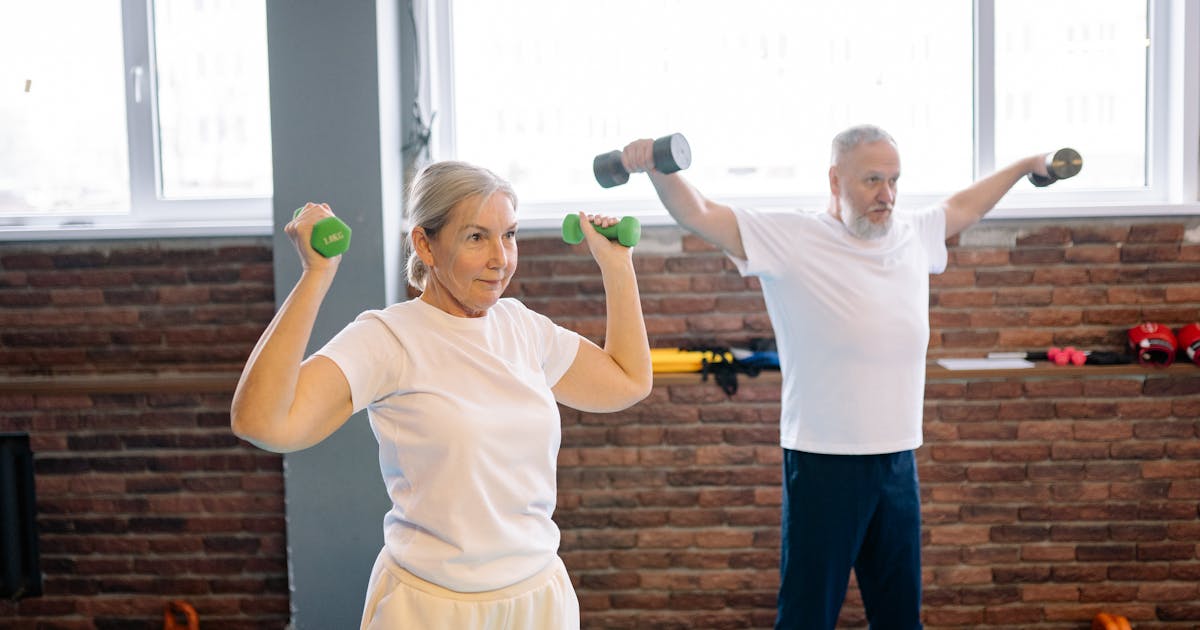
<p>The only proven way to reverse or substantially slow sarcopenia is progressive resistance training. The dose-response data are clear: two to three sessions per week of full-body resistance work, with progressive load over months, can rebuild measurable muscle mass even in adults in their 70s and 80s. The effect size is large enough that strength training meaningfully changes 5 and 10 year disability and mortality risk.</p>
<p>The specific protocol matters less than the consistency. Free weights, machines, resistance bands, bodyweight exercises (push-ups, squats, lunges, planks) all work if loaded progressively. The threshold for adaptation is meaningful effort, around 60 to 80% of maximum capacity for 8 to 12 reps per set, 2 to 3 sets per exercise, 6 to 10 exercises per session. Total session time of 30 to 45 minutes twice a week is enough for most adults to see clear gains within 8 to 12 weeks (<a href="https://www.nia.nih.gov/health/exercise-and-physical-activity/sarcopenia-and-older-adults" target="_blank" rel="noopener">NIA, 2024</a>).</p>
<h3>The Protein Side Of The Equation</h3>
<p>Older adults have reduced muscle protein synthesis efficiency, sometimes called anabolic resistance. To stimulate the same muscle-building response a 30-year-old gets from 20 grams of protein, a 70-year-old often needs 30 to 40 grams. The implication is that protein intake recommendations rise with age, not fall. Current evidence supports about 1.2 to 1.6 grams of protein per kilogram body weight per day for adults 65+, ideally distributed across 3 to 4 meals with at least 25 to 30 grams per meal.</p>
<p>The combination of progressive resistance training plus adequate protein produces dramatically better outcomes than either alone. Adults who lift weights but undereat protein gain less muscle than they could. Adults who eat protein but do not lift gain almost nothing. The two interventions work synergistically and most clinical protocols pair them deliberately.</p>
<!-- SECTION 4: YOUR ACTION PLAN -->
<div class="ac-action-plan" style="background: linear-gradient(135deg, #fffcf4 0%, #fff8ed 100%); border-left: 5px solid #9A6841; border-radius: 12px; padding: 28px 24px; margin: 32px 0; box-shadow: 0 2px 12px rgba(0,0,0,0.06);"><div style="display: flex; align-items: center; gap: 10px; margin-bottom: 20px;"><svg width="24" height="24" viewBox="0 0 24 24" fill="none" stroke="#9A6841" stroke-width="2" stroke-linecap="round" stroke-linejoin="round"><path d="M9 5H7a2 2 0 00-2 2v12a2 2 0 002 2h10a2 2 0 002-2V7a2 2 0 00-2-2h-2"/><rect x="9" y="3" width="6" height="4" rx="1"/><path d="M9 14l2 2 4-4"/></svg><span style="font-family: Georgia, serif; font-size: 22px; font-weight: 700; color: #313743;">Your Coach's Recommendations</span></div><div style="display: flex; gap: 14px; margin-bottom: 16px; align-items: flex-start;"><div style="min-width: 36px; width: 36px; height: 36px; background: #9A6841; border-radius: 50%; display: flex; align-items: center; justify-content: center; color: #fff; font-weight: 700; font-size: 16px; flex-shrink: 0;">1</div><div><div style="font-weight: 700; color: #313743; font-size: 15px; margin-bottom: 2px;">Get a Baseline DEXA Scan This Quarter.</div><div style="color: #6b7280; font-size: 13.5px; line-height: 1.5;">Most major medical centers offer DEXA for $50 to $200 self-pay. A baseline measurement gives you a starting point. Repeat annually to track muscle gain or loss. Knowing your starting composition transforms how you think about training and nutrition.</div></div></div><div style="display: flex; gap: 14px; margin-bottom: 16px; align-items: flex-start;"><div style="min-width: 36px; width: 36px; height: 36px; background: #9A6841; border-radius: 50%; display: flex; align-items: center; justify-content: center; color: #fff; font-weight: 700; font-size: 16px; flex-shrink: 0;">2</div><div><div style="font-weight: 700; color: #313743; font-size: 15px; margin-bottom: 2px;">Start a Twice-Weekly Progressive Resistance Program.</div><div style="color: #6b7280; font-size: 13.5px; line-height: 1.5;">If you have never lifted, hire a trainer for 2 to 4 sessions to learn form and design a program. The investment pays for itself many times over in injury avoidance. Focus on compound movements: squat, hinge, push, pull, carry.</div></div></div><div style="display: flex; gap: 14px; margin-bottom: 20px; align-items: flex-start;"><div style="min-width: 36px; width: 36px; height: 36px; background: #9A6841; border-radius: 50%; display: flex; align-items: center; justify-content: center; color: #fff; font-weight: 700; font-size: 16px; flex-shrink: 0;">3</div><div><div style="font-weight: 700; color: #313743; font-size: 15px; margin-bottom: 2px;">Hit 25 to 30 Grams of Protein at Each of Your Main Meals.</div><div style="color: #6b7280; font-size: 13.5px; line-height: 1.5;">Eggs, Greek yogurt, cottage cheese, chicken, fish, tofu, lentils, protein powder if needed. The per-meal threshold matters more than the total daily number; spread it across 3 to 4 meals to maximize the muscle protein synthesis response.</div></div></div><div style="border-top: 1px solid #e5ddd4; margin: 16px 0;"></div><div style="display: flex; justify-content: center; align-items: center; gap: 10px; flex-wrap: wrap;"><button onclick="acPrintPlan()" style="background: none; border: 1px solid #d3cabe; border-radius: 8px; padding: 10px 16px; font-size: 13px; color: #6b7280; cursor: pointer; display: flex; align-items: center; gap: 6px;"><svg width="14" height="14" viewBox="0 0 24 24" fill="none" stroke="currentColor" stroke-width="2" stroke-linecap="round" stroke-linejoin="round"><polyline points="6 9 6 2 18 2 18 9"/><path d="M6 18H4a2 2 0 01-2-2v-5a2 2 0 012-2h16a2 2 0 012 2v5a2 2 0 01-2 2h-2"/><rect x="6" y="14" width="12" height="8"/></svg>Print</button></div></div>
<div style="margin-top: 32px; padding-top: 0;">
<div style="width: 60px; height: 2px; background: linear-gradient(90deg, #9A6841, #be7b4c); border-radius: 2px; margin-bottom: 20px;"></div>
<p style="font-family: Georgia, serif; font-size: 16px; font-style: italic; color: #777; margin: 0 0 6px 0; letter-spacing: 0.3px; padding-left: 38px;">To your health,</p>
<div style="display: flex; align-items: center; gap: 4px; margin-bottom: 4px;">
<img src="https://cdn.prod.website-files.com/69be130d412f9c2c202307ef/69c539b9526b266e2cba5521_ageless-coach-logo-black.png" alt="AC" style="width: 34px; height: 34px; object-fit: contain;">
<p style="font-family: Georgia, serif; font-size: 22px; font-weight: 700; color: #313743; margin: 0; letter-spacing: 0.5px;">Ageless Coach</p>
</div>
<p style="font-family: -apple-system, BlinkMacSystemFont, Segoe UI, sans-serif; font-size: 11px; font-weight: 600; color: #be7b4c; letter-spacing: 2px; text-transform: uppercase; margin: 0 0 0 28px;">Age Strong. Live Long.</p>
</div>
<div style="margin-top: 28px; padding-top: 20px; border-top: 1px solid #e5e7eb; text-align: center;">
<p style="font-family: -apple-system, BlinkMacSystemFont, Segoe UI, sans-serif; font-size: 13px; font-weight: 700; color: #6b7280; letter-spacing: 2px; text-transform: uppercase; margin: 0 0 16px 0;">Trusted Sources Behind This Article</p>
<div style="display: flex; justify-content: center; gap: 10px; flex-wrap: wrap;">
<a href="https://my.clevelandclinic.org/health/diseases/23167-sarcopenia" target="_blank" rel="noopener" style="display: inline-block; background: #fff; border: 1.5px solid #9A6841; color: #9A6841; padding: 8px 20px; border-radius: 20px; font-size: 14px; font-weight: 600; letter-spacing: 0.3px; text-decoration: none; transition: background 0.2s ease, color 0.2s ease;">Cleveland Clinic</a>
<a href="https://my.clevelandclinic.org/health/diagnostics/10683-dexa-dxa-scan-bone-density-test" target="_blank" rel="noopener" style="display: inline-block; background: #fff; border: 1.5px solid #9A6841; color: #9A6841; padding: 8px 20px; border-radius: 20px; font-size: 14px; font-weight: 600; letter-spacing: 0.3px; text-decoration: none; transition: background 0.2s ease, color 0.2s ease;">Cleveland Clinic</a>
<a href="https://www.nia.nih.gov/health/exercise-and-physical-activity/sarcopenia-and-older-adults" target="_blank" rel="noopener" style="display: inline-block; background: #fff; border: 1.5px solid #9A6841; color: #9A6841; padding: 8px 20px; border-radius: 20px; font-size: 14px; font-weight: 600; letter-spacing: 0.3px; text-decoration: none; transition: background 0.2s ease, color 0.2s ease;">NIH NIA</a>
</div>
</div>
<p style="font-size: 12px; color: #999; margin-top: 40px; line-height: 1.5;"><em>This content is for educational purposes only and is not a substitute for professional medical advice, diagnosis, or treatment. Reading this article does not create a provider-patient relationship. Always consult your physician or qualified healthcare provider before making changes to your diet, exercise, or health routine. Ageless Coach is not liable for any actions taken based on this information.</em></p>
<div class="ac-faq" style="margin-top:40px; border-top:1px solid #e5e7eb; padding-top:32px;">
<h2 style="font-family:Georgia,serif; font-size:20px; font-weight:700; color:#313743; margin:0 0 20px 0;">Frequently Asked Questions</h2>
<details style="border:1px solid #e5e7eb; border-radius:8px; margin-bottom:10px; overflow:hidden;">
<summary style="padding:14px 18px; font-weight:600; font-size:15px; color:#313743; cursor:pointer; list-style:none; display:flex; justify-content:space-between; align-items:center;">
Is BMI useless for older adults then?
<svg width="16" height="16" viewBox="0 0 24 24" fill="none" stroke="#9A6841" stroke-width="2" stroke-linecap="round" stroke-linejoin="round" aria-hidden="true"><polyline points="6 9 12 15 18 9"/></svg>
</summary>
<div style="padding:0 18px 16px; font-size:18px; color:#555; line-height:1.65;">Not useless, but incomplete. BMI works reasonably well at population scale but loses accuracy as composition shifts with age. A 70-year-old with BMI 24 can be either healthy or sarcopenic, and BMI cannot tell you which. Pair BMI with waist circumference and a body composition measurement (BIA scale or DEXA) for a more useful picture.</div>
</details>
<details style="border:1px solid #e5e7eb; border-radius:8px; margin-bottom:10px; overflow:hidden;">
<summary style="padding:14px 18px; font-weight:600; font-size:15px; color:#313743; cursor:pointer; list-style:none; display:flex; justify-content:space-between; align-items:center;">
How much should I weigh at 65?
<svg width="16" height="16" viewBox="0 0 24 24" fill="none" stroke="#9A6841" stroke-width="2" stroke-linecap="round" stroke-linejoin="round" aria-hidden="true"><polyline points="6 9 12 15 18 9"/></svg>
</summary>
<div style="padding:0 18px 16px; font-size:18px; color:#555; line-height:1.65;">Less useful question than what your composition is. Mortality data in older adults actually show a slight U-shape, with the lowest mortality often in BMI 24 to 29 ranges, partly because some excess weight provides metabolic reserve during illness. The better target is preserving muscle mass and limiting visceral fat, regardless of scale number.</div>
</details>
<details style="border:1px solid #e5e7eb; border-radius:8px; margin-bottom:10px; overflow:hidden;">
<summary style="padding:14px 18px; font-weight:600; font-size:15px; color:#313743; cursor:pointer; list-style:none; display:flex; justify-content:space-between; align-items:center;">
Can I rebuild muscle if I have not lifted in decades?
<svg width="16" height="16" viewBox="0 0 24 24" fill="none" stroke="#9A6841" stroke-width="2" stroke-linecap="round" stroke-linejoin="round" aria-hidden="true"><polyline points="6 9 12 15 18 9"/></svg>
</summary>
<div style="padding:0 18px 16px; font-size:18px; color:#555; line-height:1.65;">Yes. Studies in adults 70 to 90 years old consistently show measurable muscle gains within 8 to 12 weeks of starting a structured resistance program. The rate of gain is slower than in younger adults, but the trajectory is clearly upward, not flat. The honest framing is that you can always get stronger; you cannot fully reverse all decades of loss, but you can reverse a meaningful fraction.</div>
</details>
<details style="border:1px solid #e5e7eb; border-radius:8px; margin-bottom:10px; overflow:hidden;">
<summary style="padding:14px 18px; font-weight:600; font-size:15px; color:#313743; cursor:pointer; list-style:none; display:flex; justify-content:space-between; align-items:center;">
What if I cannot do heavy weights because of joint pain?
<svg width="16" height="16" viewBox="0 0 24 24" fill="none" stroke="#9A6841" stroke-width="2" stroke-linecap="round" stroke-linejoin="round" aria-hidden="true"><polyline points="6 9 12 15 18 9"/></svg>
</summary>
<div style="padding:0 18px 16px; font-size:18px; color:#555; line-height:1.65;">Lighter loads done to muscle fatigue produce similar adaptations to heavier loads done at moderate effort. Studies on blood flow restriction training and high-rep low-load protocols show that older adults with joint limitations can still build muscle effectively. Work with a physical therapist or trainer who specializes in older adults to find the protocol that fits your specific limitations.</div>
</details>
<details style="border:1px solid #e5e7eb; border-radius:8px; margin-bottom:10px; overflow:hidden;">
<summary style="padding:14px 18px; font-weight:600; font-size:15px; color:#313743; cursor:pointer; list-style:none; display:flex; justify-content:space-between; align-items:center;">
How accurate are the home BIA scales?
<svg width="16" height="16" viewBox="0 0 24 24" fill="none" stroke="#9A6841" stroke-width="2" stroke-linecap="round" stroke-linejoin="round" aria-hidden="true"><polyline points="6 9 12 15 18 9"/></svg>
</summary>
<div style="padding:0 18px 16px; font-size:18px; color:#555; line-height:1.65;">Absolute accuracy is moderate (often within 3 to 5 percentage points of true body fat). Tracking accuracy over time is much better: if you weigh at the same time, in the same hydration state, on the same scale, the trend line is usually informative even if the absolute number is off. Use BIA for trends; use DEXA for occasional reality checks.</div>
</details>
<details style="border:1px solid #e5e7eb; border-radius:8px; margin-bottom:10px; overflow:hidden;">
<summary style="padding:14px 18px; font-weight:600; font-size:15px; color:#313743; cursor:pointer; list-style:none; display:flex; justify-content:space-between; align-items:center;">
Does creatine help older adults build muscle?
<svg width="16" height="16" viewBox="0 0 24 24" fill="none" stroke="#9A6841" stroke-width="2" stroke-linecap="round" stroke-linejoin="round" aria-hidden="true"><polyline points="6 9 12 15 18 9"/></svg>
</summary>
<div style="padding:0 18px 16px; font-size:18px; color:#555; line-height:1.65;">Yes. Creatine monohydrate, 3 to 5 grams daily, is one of the most well-studied supplements in older adults and consistently amplifies the muscle-building effect of resistance training. It is safe for most adults including those with normal kidney function. Discuss with your physician if you have kidney disease before starting.</div>
</details>
</div>
<div class="ac-article-cta">
<p class="ac-cta-lead">Want one verified-science article like this every week?</p>
<a href="/newsletter" class="ac-nav-cta">
Get Better Health, Weekly
<span class="ac-nav-cta-arrow">
<svg viewBox="0 0 18 18" fill="none" xmlns="http://www.w3.org/2000/svg" aria-hidden="true"><path d="M4.24 13.59L12.73 5.11" stroke="#0D1B2A" stroke-width="1.8"/><path d="M4.95 4.4H13.44V12.89" stroke="#0D1B2A" stroke-width="1.8"/></svg>
</span>
</a>
</div>

Get Better Health, Weekly