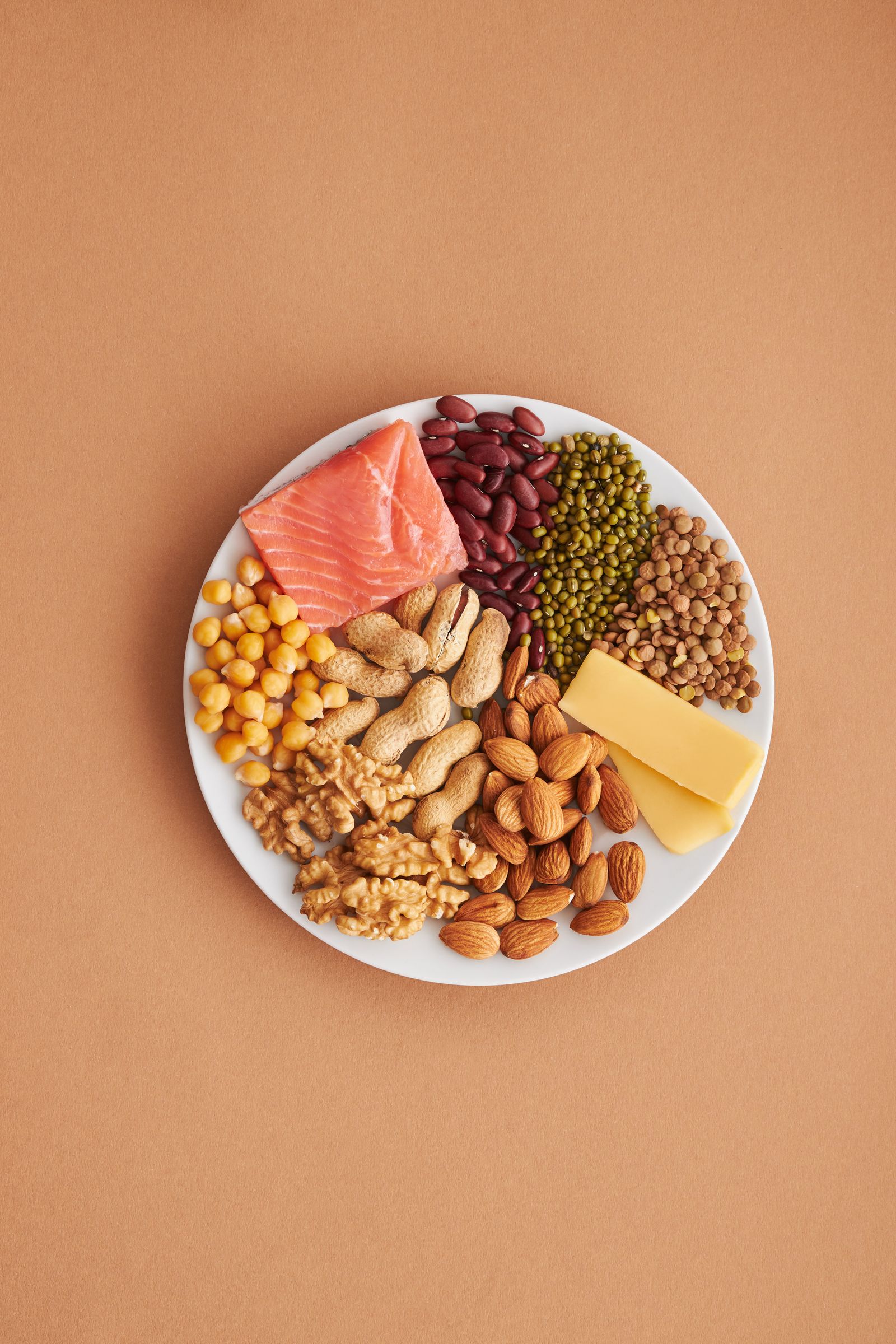
Start with the reassuring part, because it is true and almost nobody says it first. If you live in the United States and eat regular meals, you almost certainly do not have a protein deficiency. Cleveland Clinic is explicit that protein deficiencies are rare here, and that when they do happen they are mostly tied to inadequate overall food intake, often alongside a chronic condition that has affected someone's appetite.
Falling short of the amount your body would do better on is a completely different question, and a far more common one. That is the gap this page is about: the quiet signals that show up when intake drifts below what your body is asking for, what else causes each of them, and what to do in what order. The powder comes last, and only if food did not close it.
Our Pick
Momentous Whey Protein Isolate
If you have already tried the food fixes and your week still lands short, this is the tub we would buy: 20g of grass-fed whey isolate per serving, NSF Certified for Sport, no gums, fillers or artificial sweeteners.
Check Current Price at Momentous →Partner link · discount applied automatically at checkout
Ageless Coach may earn a commission if you buy through this link, at no extra cost to you. We only recommend products that pass our published screen, and this recommendation was set before any partnership. How we choose partners.
The six signs, and what else explains them
Cleveland Clinic lists eight recognised symptoms of low protein. Two of them, stunted growth on a childhood growth chart and anemia showing up on bloodwork, sit outside what an adult would notice at home. These are the six that do not. The most important line in the whole source is this one: there is rarely just one symptom, so you will more than likely experience several together. A single item on this table is usually something else.
Six Signals, Honestly Read
| Sign | What it can look like | What else commonly causes it |
|---|
| Muscle loss | Your body draws on the protein stored in muscle to cover more essential functions | Ageing itself, inactivity, and the absence of resistance training |
| Hair and skin changes | Brittle hair that breaks easily, dry or pale-looking skin, and in some cases rapid shedding | Thyroid conditions, iron status, stress, and ordinary seasonal shedding |
| Getting sick more often | Your body needs protein to build the antibodies that clear bacteria, viruses and toxins | Sleep debt, a new exposure environment, and other nutrient shortfalls |
| Swelling | Fluid held in the tissues, typically on both sides of the body, hands and legs | A long list. Cleveland Clinic notes that if swelling is your only symptom it is not necessarily protein |
| Bone fractures | Collagen is the main protein in bone, and bone needs it to stay strong and flexible | Calcium and vitamin D status, bone density, and mechanical loading |
| Unexplained weight change | Moving in either direction, including gaining while eating the same as always | Medication changes, thyroid function, and shifts in activity |
Every row above is drawn from Cleveland Clinic and fetched live at build. Note the mechanism behind that last row, because it is the one people misread: Cleveland Clinic explains that losing muscle slows metabolism, so if calorie intake then returns to its usual baseline you can gain while eating exactly what you always ate. The scale moves without the diet changing.
The number you are actually aiming at
Most people have never calculated it. Cleveland Clinic gives the arithmetic plainly: the most common recommendation is 0.8 to 1 gram of protein per kilogram of body weight per day, so divide your weight in pounds by 2.205 and multiply by 0.8 for the floor. For someone at 170 pounds that lands near 62 grams a day as a minimum.
Then it adds the part that matters here. Cleveland Clinic notes that older adults can benefit from more protein to counteract muscle loss, which begins as early as the thirties and forties and accelerates around 65, and that muscle mass and activity level shift the number more than sex does. Harvard Health reports research suggesting healthy older adults need meaningfully more than the floor to counter lost muscle mass, and that protein combined with resistance exercise produces the largest improvements in muscle mass and strength. Protein on its own is the weaker half of that pair.
Fix it with food first, in this order
1. Put protein at every meal
Cleveland Clinic's dietitian advises against cramming the day's protein into one meal, because spreading it out makes the daily total easier to hit.
2. Know what a serving actually gives you
Three ounces of grilled chicken is about 29.5 grams, salmon about 21.6, a container of nonfat Greek yogurt about 19.9, one large egg about 6.3, per
Cleveland Clinic.
3. Vary plant sources if you eat mostly plants
Many plant proteins are incomplete, so
Cleveland Clinic advises eating a variety to cover all nine essential amino acids.
4. Pick the better animal sources
Cleveland Clinic flags processed meats and grain-fed red meat as the weaker choices, high in sodium and saturated fat.
The honest limitation, stated up front
A powder is a gap-filler, and it should be sold that way.
Cleveland Clinic is direct on the hierarchy: getting whole food sources of protein is best, but if it is the difference between meeting your protein needs and not meeting them, that is where shakes and bars can help fill in the gaps. Whole foods also carry vitamins, minerals and fiber that a scoop does not. If breakfast and lunch close your gap, you never needed the tub, and we would rather you kept the money.
Why not just buy the cheapest tub?
Does the certification actually matter?
It is the main thing separating tubs at this price point. NSF Certified for Sport means an independent laboratory has confirmed the contents match the label and screened the batch for banned substances and contaminant limits. Supplements are not held to the standards that apply to food and medicine, so third-party verification is doing real work rather than decorating the packaging.
Isolate or concentrate?
Isolate is filtered further, so it carries more protein per scoop and less lactose and fat than concentrate. Concentrate is cheaper per serving and fine for many people. If dairy has been sitting badly with you, isolate is the more comfortable option, though it is not lactose-free and a severe intolerance is a conversation for a professional.
What if several of the six signs apply to me?
Then this stops being a shopping question.
Cleveland Clinic advises talking with a healthcare provider if a change in appetite is affecting your desire to eat, and notes that low protein can show up on bloodwork as
hypoproteinemia. A provider can also check whether something else is driving the cluster.
Can more protein cause problems?
For most healthy adults, no. But
Cleveland Clinic is clear that people living with kidney disease may be advised to keep protein intake on the lower end, because clearing excess protein puts additional work on kidneys that are not filtering at full speed. If that is you, the target is your provider's call, not an article's.
📋 Your Coach's Recommendations
1
Count the signals before you count the grams.
Write down which of the six you have actually noticed and for how long. One on its own is usually something else. Several together is worth acting on.
2
Do the arithmetic once, then fix breakfast.
Weight in pounds divided by 2.205, times 0.8, is your floor. Then add a real protein source to the first meal of the day and hold it for two weeks. Most gaps close right there, for free.
3
Only then consider a screened powder.
If food genuinely does not reach the number on your ordinary weeks, a certified isolate covers the shortfall without replacing meals.
Not buying yet? Good. Download the free
Protein Signals Plan (PDF), 2 pages, with the target math, the six-signal checklist and every claim on this page traced to its source. No email required.
Sources
Every claim on this page was verified against these Tier-1 sources, fetched live at build:
Cleveland Clinic · 8 Symptoms of Protein Deficiency
Cleveland Clinic · How Much Protein Do You Need? And How To Get It
Cleveland Clinic · What Are the Best and Worst Sources of Protein?
Cleveland Clinic · What Are Complete Proteins?
Cleveland Clinic · Low Protein in Blood (Hypoproteinemia)
Harvard Health Publishing · Muscle loss and protein needs in older adults
Momentous product specification and Certificate of Analysis pages: Whey Protein Isolate and Certificates of Analysis
By the Ageless Coach Editorial Team · July 19, 2026 · Sources: Cleveland Clinic, Harvard Health Publishing, and Momentous manufacturer disclosures
Affiliate disclosure: This article contains affiliate links. If you buy through one, Ageless Coach may earn a commission at no additional cost to you. Our pick was made independently and set before any partnership. How we choose partners.
This content is educational and is not a substitute for professional medical advice, diagnosis, or treatment. These statements have not been evaluated by the Food and Drug Administration. This product is not intended to diagnose, treat, cure, or prevent any disease. Always consult your physician before making changes to your health routine.
<style>
.ac-int-b{--dark-base:#0D1B2A;--dark-mid:#1B3A4B;--teal:#0EA5A0;--teal-dark:#0C8C88;--teal-bright:#14D4CD;--fog:#D8E8E8;--deep-fog:#C8DCDC;--fog-border:#A8C4C4;--ink:#313743;--ink-soft:#49505f;--muted:#6b7280;--warm:#9A6841;--serif:"Source Serif 4",Georgia,serif;--sans:Inter,-apple-system,"Segoe UI",sans-serif}
.ac-int-b *{box-sizing:border-box}.ac-int-b html{scroll-behavior:smooth}
.ac-int-b body{margin:0;background:#fff;color:var(--ink);font-family:var(--sans);-webkit-font-smoothing:antialiased}
.ac-int-b .wrap{max-width:820px;margin:0 auto;padding:26px 20px 60px}
.ac-int-b h1{font-family:var(--serif);font-size:40px;line-height:1.15;font-weight:800;color:var(--ink);margin:0 0 14px}
.ac-int-b .lead{font-size:18px;color:var(--muted);margin:0 0 26px;line-height:1.6}
.ac-int-b p{font-size:18.5px;line-height:1.7;color:var(--ink-soft);margin:0 0 20px}
.ac-int-b p strong{color:var(--ink)}
.ac-int-b p a{color:var(--teal-dark);font-weight:700;text-decoration:underline;text-decoration-color:rgba(14,165,160,.4);text-underline-offset:3px}
.ac-int-b .pick{position:relative;border:2px solid var(--teal);border-radius:16px;box-shadow:0 10px 30px rgba(13,27,42,.10);padding:22px 24px 18px;margin:8px 0 12px;background:linear-gradient(180deg,#F0F7F7,#fff)}
.ac-int-b .pick .rib{position:absolute;top:-13px;left:22px;background:var(--teal-dark);color:#fff;font:800 11.5px/1 var(--sans);letter-spacing:2px;text-transform:uppercase;padding:8px 15px;border-radius:20px}
.ac-int-b .pick h2{font-family:var(--serif);font-size:24px;line-height:1.15;font-weight:800;color:var(--dark-base);margin:0 0 6px}
.ac-int-b .pick .why{font:600 14.5px/1.5 var(--sans);color:var(--ink);margin:0 0 12px}
.ac-int-b .pick .cta{display:inline-flex;align-items:center;gap:8px;background:var(--teal-dark);color:#fff;font:800 15px/1 var(--sans);padding:14px 26px;border-radius:50px;text-decoration:none;box-shadow:0 8px 20px rgba(12,140,136,.28)}
.ac-int-b .pending{display:block;color:#4E6B6B;font:500 11.5px/1.5 var(--sans);margin:8px 0 0;letter-spacing:.01em}
.ac-int-b .pick .ftc{font:500 12px/1.6 var(--sans);color:var(--muted);margin:12px 0 0}
.ac-int-b .pick .ftc a{color:var(--teal-dark);font-weight:600}
.ac-int-b .cmp{border:1.5px solid var(--fog-border);border-radius:16px;overflow:hidden;margin:30px 0 8px;box-shadow:0 8px 26px rgba(13,27,42,.08)}
.ac-int-b .cmp .chead{background:var(--dark-base);color:#fff;padding:16px 22px;font:800 14px/1.3 var(--sans);letter-spacing:1.5px;text-transform:uppercase}
.ac-int-b .cmp table{width:100%;border-collapse:collapse}
.ac-int-b .cmp th,.ac-int-b .cmp td{padding:13px 13px;font:500 14px/1.5 var(--sans);color:var(--ink-soft);border-bottom:1px solid #E9F1F1;text-align:left;vertical-align:top}
.ac-int-b .cmp th{font-weight:800;color:var(--dark-mid);background:#F4FAFA;font-size:12.5px;letter-spacing:.3px}
.ac-int-b .cmp td.name{font-weight:800;color:var(--dark-mid);white-space:nowrap}
.ac-int-b .cmp tr.rec td{background:#E9F7F6}
.ac-int-b .cmp td.win{font-weight:700;color:var(--dark-mid)}
.ac-int-b .cmp tr:last-child td{border-bottom:none}
.ac-int-b .legend{font:500 12.5px/1.5 var(--sans);color:var(--muted);margin:8px 2px 0}
.ac-int-b h3.sec{font-family:var(--serif);font-size:25px;font-weight:800;color:var(--ink);margin:40px 0 12px}
.ac-int-b .crit{display:grid;grid-template-columns:1fr 1fr;gap:12px;margin:16px 0}
.ac-int-b .crit .c{background:linear-gradient(180deg,#F0F7F7,#fff);border:1px solid var(--fog-border);border-radius:12px;padding:15px 17px}
.ac-int-b .crit .c .t{font:800 13.5px/1.3 var(--sans);color:var(--dark-mid);margin-bottom:5px}
.ac-int-b .crit .c .d{font:500 13.5px/1.5 var(--sans);color:var(--ink-soft)}
.ac-int-b .callout{border-left:4px solid var(--teal);background:#F4FAFA;border-radius:0 12px 12px 0;padding:18px 22px;margin:24px 0}
.ac-int-b .callout .n{font:800 17px/1.35 var(--sans);color:var(--dark-mid);margin-bottom:6px}
.ac-int-b .callout .d{font:500 15px/1.55 var(--sans);color:var(--ink-soft)}
.ac-int-b .objs{margin:14px 0 0}
.ac-int-b .objs details{border:1px solid #e5e7eb;border-radius:10px;margin-bottom:10px}
.ac-int-b .objs summary{padding:15px 18px;font:700 15.5px/1.4 var(--sans);color:var(--ink);cursor:pointer;display:flex;justify-content:space-between;gap:12px;list-style:none}
.ac-int-b .objs summary::-webkit-details-marker{display:none}
.ac-int-b .objs summary:after{content:"\25BE";color:var(--teal-dark)}
.ac-int-b .objs .a{padding:0 18px 16px;font-size:15.5px;line-height:1.6;color:#555}
.ac-int-b .plan{background:linear-gradient(135deg,#F4FAFA,#fff);border-left:5px solid var(--teal-dark);border-radius:14px;padding:26px;margin:38px 0 0;box-shadow:0 2px 12px rgba(0,0,0,.06)}
.ac-int-b .plan .pt{font-family:var(--serif);font-size:22px;font-weight:800;color:var(--ink);margin-bottom:18px}
.ac-int-b .plan .step{display:flex;gap:14px;margin-bottom:15px;align-items:flex-start}
.ac-int-b .plan .step .n{min-width:34px;width:34px;height:34px;background:var(--teal-dark);border-radius:50%;color:#fff;font:800 15px/34px var(--sans);text-align:center;flex-shrink:0}
.ac-int-b .plan .sh{font:800 15.5px/1.4 var(--sans);color:var(--ink);margin-bottom:3px}
.ac-int-b .plan .sd{font:400 14.5px/1.55 var(--sans);color:var(--muted)}
.ac-int-b .plan .midcta{border-top:1px solid #D8E8E8;margin-top:14px;padding-top:16px;text-align:center}
.ac-int-b .buy{display:inline-flex;align-items:center;gap:8px;background:var(--teal-dark);color:#fff;font:800 15px/1 var(--sans);padding:14px 26px;border-radius:50px;text-decoration:none}
.ac-int-b .capline{border-top:1px solid #E2ECEC;margin-top:34px;padding:22px 10px 0;text-align:center;font:500 15px/1.6 var(--sans);color:#3A5555}
.ac-int-b .capline a{color:var(--teal-dark);font-weight:700}
.ac-int-b .meta{font:500 12.5px/1.6 var(--sans);color:#98a0a6;text-align:center;margin:26px 0 0}
@media(max-width:600px){.ac-int-b .crit{grid-template-columns:1fr}.ac-int-b h1{font-size:31px}.ac-int-b .cmp th,.ac-int-b .cmp td{padding:10px 9px;font-size:12.5px}}
.ac-int-b .disc{max-width:820px;margin:0 auto;padding:20px 20px 30px;text-align:center;font:500 12.5px/1.6 var(--sans);color:#8a9298}
@media(max-width:600px){
.ac-int-b .cmp table,.ac-int-b .cmp tbody,.ac-int-b .cmp tr,.ac-int-b .cmp td{display:block;width:100%;box-sizing:border-box}
.ac-int-b .cmp tr:first-child{display:none}
.ac-int-b .cmp tr{padding:0 0 13px;border-bottom:6px solid #F4FAFA}
.ac-int-b .cmp tr:last-child{border-bottom:none}
.ac-int-b .cmp td{border-bottom:none;padding:5px 18px;font-size:14.5px;line-height:1.5}
.ac-int-b .cmp td.name{white-space:normal;padding-top:13px;padding-bottom:6px;font-size:15.5px}
.ac-int-b .cmp td[data-l]:before{content:attr(data-l);display:block;font:800 10.5px/1.4 var(--sans);letter-spacing:.8px;text-transform:uppercase;color:var(--muted);margin-bottom:1px}
.ac-int-b .cmp tr.rec{border-left:4px solid var(--teal-dark)}
}
</style>
<div class="ac-int-b">
<div class="wrap">
<p><strong>Start with the reassuring part, because it is true and almost nobody says it first.</strong> If you live in the United States and eat regular meals, you almost certainly do not have a protein deficiency. <a href="https://health.clevelandclinic.org/protein-deficiency-symptoms" target="_blank" rel="noopener">Cleveland Clinic</a> is explicit that protein deficiencies are rare here, and that when they do happen they are mostly tied to inadequate overall food intake, often alongside a chronic condition that has affected someone's appetite.</p>
<p>Falling short of the amount your body would do better on is a completely different question, and a far more common one. That is the gap this page is about: the quiet signals that show up when intake drifts below what your body is asking for, what else causes each of them, and what to do in what order. The powder comes last, and only if food did not close it.</p>
<div class="pick">
<div class="rib">Our Pick</div>
<h2>Momentous Whey Protein Isolate</h2>
<div class="why">If you have already tried the food fixes and your week still lands short, this is the tub we would buy: 20g of grass-fed whey isolate per serving, NSF Certified for Sport, no gums, fillers or artificial sweeteners.</div>
<a class="cta" href="https://www.livemomentous.com/products/essential-whey-protein?dc=AgelessCoach&mct=pwqwZOO1&utm_source=agelesscoach&utm_medium=intent-article&utm_content=tmpl-B" data-affiliate="momentous" data-template="B" data-code="AgelessCoach" rel="noopener sponsored">Check Current Price at Momentous →</a><span class="pending">Partner link · discount applied automatically at checkout</span>
<p class="ftc">Ageless Coach may earn a commission if you buy through this link, at no extra cost to you. We only recommend products that pass our published screen, and this recommendation was set before any partnership. <a href="/partners">How we choose partners</a>.</p>
</div>
<h3 class="sec">The six signs, and what else explains them</h3>
<p><a href="https://health.clevelandclinic.org/protein-deficiency-symptoms" target="_blank" rel="noopener">Cleveland Clinic</a> lists eight recognised symptoms of low protein. Two of them, stunted growth on a childhood growth chart and anemia showing up on bloodwork, sit outside what an adult would notice at home. These are the six that do not. The most important line in the whole source is this one: there is rarely just one symptom, so you will more than likely experience several together. A single item on this table is usually something else.</p>
<div class="cmp">
<div class="chead">Six Signals, Honestly Read</div>
<table>
<tr><th>Sign</th><th>What it can look like</th><th>What else commonly causes it</th></tr>
<tr class="rec"><td class="name">Muscle loss</td><td data-l="What it can look like" class="win">Your body draws on the protein stored in muscle to cover more essential functions</td><td data-l="What else commonly causes it" class="win">Ageing itself, inactivity, and the absence of resistance training</td></tr>
<tr><td class="name">Hair and skin changes</td><td data-l="What it can look like">Brittle hair that breaks easily, dry or pale-looking skin, and in some cases rapid shedding</td><td data-l="What else commonly causes it">Thyroid conditions, iron status, stress, and ordinary seasonal shedding</td></tr>
<tr><td class="name">Getting sick more often</td><td data-l="What it can look like">Your body needs protein to build the antibodies that clear bacteria, viruses and toxins</td><td data-l="What else commonly causes it">Sleep debt, a new exposure environment, and other nutrient shortfalls</td></tr>
<tr><td class="name">Swelling</td><td data-l="What it can look like">Fluid held in the tissues, typically on both sides of the body, hands and legs</td><td data-l="What else commonly causes it">A long list. Cleveland Clinic notes that if swelling is your only symptom it is not necessarily protein</td></tr>
<tr><td class="name">Bone fractures</td><td data-l="What it can look like">Collagen is the main protein in bone, and bone needs it to stay strong and flexible</td><td data-l="What else commonly causes it">Calcium and vitamin D status, bone density, and mechanical loading</td></tr>
<tr><td class="name">Unexplained weight change</td><td data-l="What it can look like">Moving in either direction, including gaining while eating the same as always</td><td data-l="What else commonly causes it">Medication changes, thyroid function, and shifts in activity</td></tr>
</table>
</div>
<p class="legend">Every row above is drawn from <a href="https://health.clevelandclinic.org/protein-deficiency-symptoms" target="_blank" rel="noopener">Cleveland Clinic</a> and fetched live at build. Note the mechanism behind that last row, because it is the one people misread: <a href="https://health.clevelandclinic.org/protein-deficiency-symptoms" target="_blank" rel="noopener">Cleveland Clinic</a> explains that losing muscle slows metabolism, so if calorie intake then returns to its usual baseline you can gain while eating exactly what you always ate. The scale moves without the diet changing.</p>
<h3 class="sec">The number you are actually aiming at</h3>
<p>Most people have never calculated it. <a href="https://health.clevelandclinic.org/how-much-protein-you-need" target="_blank" rel="noopener">Cleveland Clinic</a> gives the arithmetic plainly: the most common recommendation is 0.8 to 1 gram of protein per kilogram of body weight per day, so divide your weight in pounds by 2.205 and multiply by 0.8 for the floor. For someone at 170 pounds that lands near 62 grams a day as a minimum.</p>
<p>Then it adds the part that matters here. <a href="https://health.clevelandclinic.org/how-much-protein-you-need" target="_blank" rel="noopener">Cleveland Clinic</a> notes that older adults can benefit from more protein to counteract muscle loss, which begins as early as the thirties and forties and accelerates around 65, and that muscle mass and activity level shift the number more than sex does. <a href="https://www.health.harvard.edu/staying-healthy/muscle-loss-and-protein-needs-in-older-adults" target="_blank" rel="noopener">Harvard Health</a> reports research suggesting healthy older adults need meaningfully more than the floor to counter lost muscle mass, and that protein combined with resistance exercise produces the largest improvements in muscle mass and strength. Protein on its own is the weaker half of that pair.</p>
<h3 class="sec">Fix it with food first, in this order</h3>
<div class="crit">
<div class="c"><div class="t">1. Put protein at every meal</div><div class="d"><a href="https://health.clevelandclinic.org/protein-deficiency-symptoms" target="_blank" rel="noopener">Cleveland Clinic</a>'s dietitian advises against cramming the day's protein into one meal, because spreading it out makes the daily total easier to hit.</div></div>
<div class="c"><div class="t">2. Know what a serving actually gives you</div><div class="d">Three ounces of grilled chicken is about 29.5 grams, salmon about 21.6, a container of nonfat Greek yogurt about 19.9, one large egg about 6.3, per <a href="https://health.clevelandclinic.org/how-much-protein-you-need" target="_blank" rel="noopener">Cleveland Clinic</a>.</div></div>
<div class="c"><div class="t">3. Vary plant sources if you eat mostly plants</div><div class="d">Many plant proteins are incomplete, so <a href="https://health.clevelandclinic.org/do-i-need-to-worry-about-eating-complete-proteins" target="_blank" rel="noopener">Cleveland Clinic</a> advises eating a variety to cover all nine essential amino acids.</div></div>
<div class="c"><div class="t">4. Pick the better animal sources</div><div class="d"><a href="https://health.clevelandclinic.org/best-and-worst-sources-of-protein" target="_blank" rel="noopener">Cleveland Clinic</a> flags processed meats and grain-fed red meat as the weaker choices, high in sodium and saturated fat.</div></div>
</div>
<h3 class="sec">The honest limitation, stated up front</h3>
<div class="callout"><div class="n">A powder is a gap-filler, and it should be sold that way.</div><div class="d"><a href="https://health.clevelandclinic.org/protein-deficiency-symptoms" target="_blank" rel="noopener">Cleveland Clinic</a> is direct on the hierarchy: getting whole food sources of protein is best, but if it is the difference between meeting your protein needs and not meeting them, that is where shakes and bars can help fill in the gaps. Whole foods also carry vitamins, minerals and fiber that a scoop does not. If breakfast and lunch close your gap, you never needed the tub, and we would rather you kept the money.</div></div>
<h3 class="sec">Why not just buy the cheapest tub?</h3>
<div class="objs">
<details><summary>Does the certification actually matter?</summary><div class="a">It is the main thing separating tubs at this price point. NSF Certified for Sport means an independent laboratory has confirmed the contents match the label and screened the batch for banned substances and contaminant limits. Supplements are not held to the standards that apply to food and medicine, so third-party verification is doing real work rather than decorating the packaging.</div></details>
<details><summary>Isolate or concentrate?</summary><div class="a">Isolate is filtered further, so it carries more protein per scoop and less lactose and fat than concentrate. Concentrate is cheaper per serving and fine for many people. If dairy has been sitting badly with you, isolate is the more comfortable option, though it is not lactose-free and a severe intolerance is a conversation for a professional.</div></details>
<details><summary>What if several of the six signs apply to me?</summary><div class="a">Then this stops being a shopping question. <a href="https://health.clevelandclinic.org/protein-deficiency-symptoms" target="_blank" rel="noopener">Cleveland Clinic</a> advises talking with a healthcare provider if a change in appetite is affecting your desire to eat, and notes that low protein can show up on bloodwork as <a href="https://my.clevelandclinic.org/health/diseases/low-protein-in-blood-hypoproteinemia" target="_blank" rel="noopener">hypoproteinemia</a>. A provider can also check whether something else is driving the cluster.</div></details>
<details><summary>Can more protein cause problems?</summary><div class="a">For most healthy adults, no. But <a href="https://health.clevelandclinic.org/how-much-protein-you-need" target="_blank" rel="noopener">Cleveland Clinic</a> is clear that people living with kidney disease may be advised to keep protein intake on the lower end, because clearing excess protein puts additional work on kidneys that are not filtering at full speed. If that is you, the target is your provider's call, not an article's.</div></details>
</div>
<div class="plan"><div class="pt">📋 Your Coach's Recommendations</div>
<div class="step"><div class="n">1</div><div><div class="sh">Count the signals before you count the grams.</div><div class="sd">Write down which of the six you have actually noticed and for how long. One on its own is usually something else. Several together is worth acting on.</div></div></div>
<div class="step"><div class="n">2</div><div><div class="sh">Do the arithmetic once, then fix breakfast.</div><div class="sd">Weight in pounds divided by 2.205, times 0.8, is your floor. Then add a real protein source to the first meal of the day and hold it for two weeks. Most gaps close right there, for free.</div></div></div>
<div class="step"><div class="n">3</div><div><div class="sh">Only then consider a screened powder.</div><div class="sd">If food genuinely does not reach the number on your ordinary weeks, a certified isolate covers the shortfall without replacing meals.</div></div></div>
<div class="midcta"><a class="buy" href="https://www.livemomentous.com/products/essential-whey-protein?dc=AgelessCoach&mct=pwqwZOO1&utm_source=agelesscoach&utm_medium=intent-article&utm_content=tmpl-B" data-affiliate="momentous" data-template="B" data-code="AgelessCoach" rel="noopener sponsored">Check Current Price at Momentous →</a><span class="pending">Partner link · discount applied automatically at checkout</span></div>
</div>
<div class="capline">Not buying yet? Good. Download the free <a href="https://cdn.prod.website-files.com/69be1026a027224999b7936b/6a5d6080d53727dee35de0b5_ageless-coach-the-protein-signals-plan-2026-07-19.pdf" target="_blank" rel="noopener" data-pdf-url="https://cdn.prod.website-files.com/69be1026a027224999b7936b/6a5d6080d53727dee35de0b5_ageless-coach-the-protein-signals-plan-2026-07-19.pdf">Protein Signals Plan (PDF)</a>, 2 pages, with the target math, the six-signal checklist and every claim on this page traced to its source. No email required.</div>
<h3 class="sec">Sources</h3>
<p style="font-size:15px;line-height:1.8">Every claim on this page was verified against these Tier-1 sources, fetched live at build:<br>
<a href="https://health.clevelandclinic.org/protein-deficiency-symptoms" target="_blank" rel="noopener">Cleveland Clinic · 8 Symptoms of Protein Deficiency</a><br>
<a href="https://health.clevelandclinic.org/how-much-protein-you-need" target="_blank" rel="noopener">Cleveland Clinic · How Much Protein Do You Need? And How To Get It</a><br>
<a href="https://health.clevelandclinic.org/best-and-worst-sources-of-protein" target="_blank" rel="noopener">Cleveland Clinic · What Are the Best and Worst Sources of Protein?</a><br>
<a href="https://health.clevelandclinic.org/do-i-need-to-worry-about-eating-complete-proteins" target="_blank" rel="noopener">Cleveland Clinic · What Are Complete Proteins?</a><br>
<a href="https://my.clevelandclinic.org/health/diseases/low-protein-in-blood-hypoproteinemia" target="_blank" rel="noopener">Cleveland Clinic · Low Protein in Blood (Hypoproteinemia)</a><br>
<a href="https://www.health.harvard.edu/staying-healthy/muscle-loss-and-protein-needs-in-older-adults" target="_blank" rel="noopener">Harvard Health Publishing · Muscle loss and protein needs in older adults</a><br>
Momentous product specification and Certificate of Analysis pages: <a href="https://www.livemomentous.com/products/essential-whey-protein" target="_blank" rel="noopener">Whey Protein Isolate</a> and <a href="https://www.livemomentous.com/pages/coa-page" target="_blank" rel="noopener">Certificates of Analysis</a></p>
<p class="meta">By the Ageless Coach Editorial Team · July 19, 2026 · Sources: Cleveland Clinic, Harvard Health Publishing, and Momentous manufacturer disclosures</p>
<p class="meta" style="margin-top:12px"><strong style="color:#6b7280">Affiliate disclosure:</strong> This article contains affiliate links. If you buy through one, Ageless Coach may earn a commission at no additional cost to you. Our pick was made independently and set before any partnership. <a href="/partners" style="color:#0C8C88;font-weight:700">How we choose partners</a>.</p>
</div>
<div class="disc">This content is educational and is not a substitute for professional medical advice, diagnosis, or treatment. These statements have not been evaluated by the Food and Drug Administration. This product is not intended to diagnose, treat, cure, or prevent any disease. Always consult your physician before making changes to your health routine.</div>
</div>